
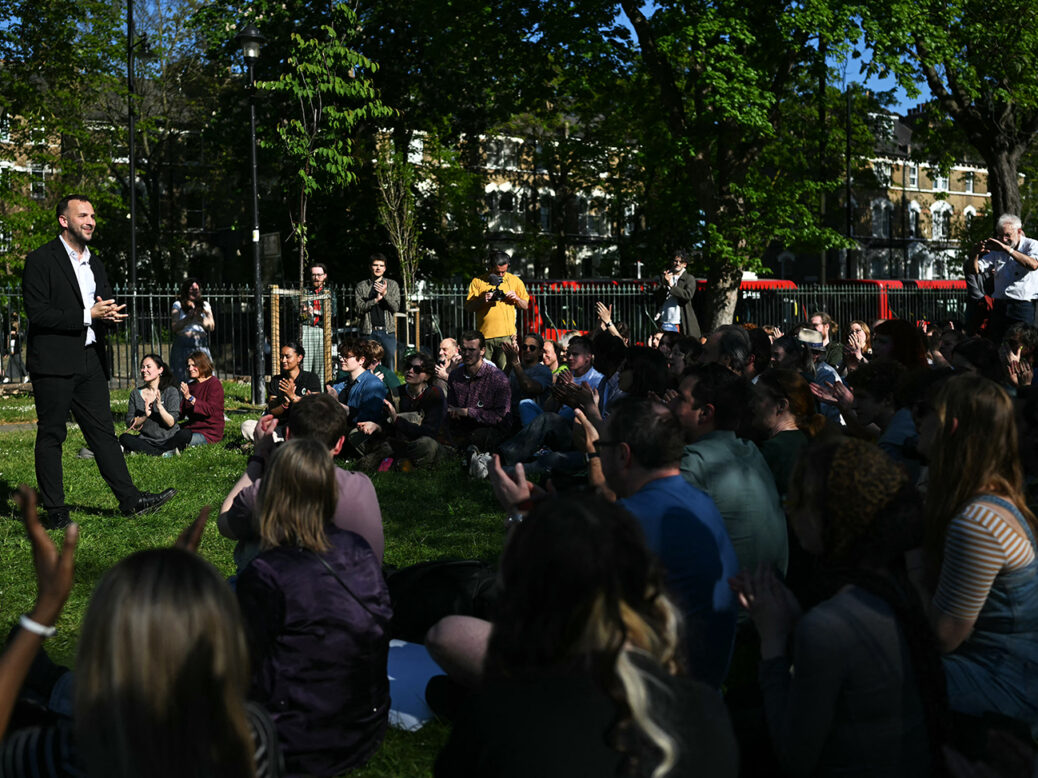
It was a warm Thursday evening in late April, and I was on the Number 35 bus in south London, travelling from Herne Hill to Brixton. I was accompanying Michael Chessum, a former speechwriter for Jeremy Corbyn turned Green Party candidate for the Brixton Acre Lane ward in Lambeth in the upcoming local elections. We were on our way to join some of his fellow Green candidates for an evening on the doorstep.
As we left Herne Hill, Chessum was grinning at his phone. The campaigners we were on our way to meet had texted to say that a group of miserable-looking Labour activists had also gathered in the same area as a gaggle of enthusiastic Greens. Chessum’s baby daughter was strapped to his front in a black papoose. Several of his colleagues described her as his “secret weapon”; she has accompanied him on most of his door-knocking rounds. She chortled and giggled, peeking out at me – a red-haired stranger with a notebook – while listening intently to her dad. As we walked down towards Brixton’s Ritzy Cinema, a motorbike zoomed past, its engine revving and briefly drowning out the street. “That comes up on the doorstep a lot,” Chessum said.
Soon after, we met Chessum’s co-candidates for the central Lambeth ward of Brixton Acre Lane, Dario Goodwin and Nat Kane. The trio felt confident – but not complacent – that they could all be elected on Thursday. Lambeth Council has been under Labour control since 2006. It was formerly led by the Housing Secretary and Keir Starmer ally, Steve Reed. It’s also where Morgan McSweeney, Starmer’s former chief of staff, cut his teeth as a political adviser. In this historically deep-red borough, could 7 May bring the first cracks of Green?
The campaign has not been without difficulties. On the day I travelled from the New Statesman’s offices in Farringdon to meet campaigners, two of the group’s candidates – Saiqa Ali and Sabine Mairey – were arrested over alleged anti-Semitic social media posts. Both have since been suspended from the party. The Green candidates I met that evening declined to comment, citing the live police investigation.

A spokesperson for Lambeth Greens said: “The Green Party is an anti-racist party, and we have robust internal processes to look into any conduct which is not in line with our values.” They added: “We cannot comment further while a police investigation is ongoing.” Zack Polanski, the party’s deputy leader, has since said he will work to strengthen candidate vetting processes, though he has faced criticism for not taking the issue seriously enough. On the doorstep in Lambeth, the party’s response to anti-Semitism was an issue: in one instance an elderly voter cited that as the reason they would not vote Green. On 3 May, the Lambeth Greens came under pressure once again after Mairey was spotted on the doorstep with other Green candidates. A Labour Party social media post which pictured her leafletting quickly went viral. It is understood that the central Green Party did not know about Mairey’s presence on the doorstep – suspended candidates are forbidden from campaigning for the party – and that she would be contacted by the party to remind her of the rules.
The Housing Secretary, Steve Reed – who previously led Lambeth Council – has been vocally critical of the Greens’ handling of the anti-Semitism. Speaking to me on the eve of polling day, Reed accused the Greens of failing to act decisively. “In the last ten days there’s been scrutiny on the Greens that there hasn’t been up until now,” he said. “They don’t seem to have been taking these allegations of breaking the law and inciting racial hatred seriously.”
Reed is clearly concerned about the prospect of a Green breakthrough in Lambeth. He draws comparisons with the leadership of Ted Knight – “Red Ted” – a former Labour leader of the council in the late 1970s and early 1980s. “It brought Lambeth into massive disrepute,” he said. McSweeney, who advised Reed during his time as council leader, is known to have little regard for Knight’s style of politics. As Patrick Maguire and Gabriel Pogrund write in Get In, McSweeney saw Knight as “the gombeen man of south London”. In response to Reed’s comments, a spokesperson for Lambeth Greens said: “For 20 years, Lambeth Labour administrations led by figures like Steve Reed have presided over an addiction to outsourcing and lining the pockets of private developers at the expense of working class people, while our local services have been shredded by cuts. Lambeth is now the second most complained about council in England. Voters will judge for themselves.”
Knight’s brand of leftism – particularly his focus on international causes – mirrors a criticism often levelled at the Greens: that they are too focused on issues like Gaza at the expense of local concerns. In an interview on the Today programme on 6 May, Polanski agreed with the sentiments of candidates who have said “Palestine is on the ballot”.
Yet many Lambeth residents appear dissatisfied with the Labour administration. At almost every door I visited with the Greens, housing emerged as a central concern. In a council block in Brixton, a woman in late middle age showed us damp creeping up her stairwell walls, causing paint to peel and flake. Initially adamant she would not vote Green, she added: “Labour really do need to do more. They make a fuss about fireproof doors, but they don’t do anything about peeling paint.”
Housing has been a defining issue in this election. Lambeth has longest waiting lists for social housing, and the council has faced scrutiny from both the Housing Ombudsman and the Regulator of Social Housing. The Greens have sought to capitalise on this, centring their campaign on repairs, maintenance, and renovation.
Among Labour activists, morale is low. With Keir Starmer struggling in the polls and a series of unpopular decisions alienating voters, some members have opted out of campaigning altogether. Local decisions – such as cancelling the Lambeth Country Show – have not helped. One Labour member in a ward likely to be won by the Greens told me: “We’re trying our best, but the energy is with the Greens. Even the most reliable Labour wards are at risk.”
Goodwin, now running alongside Chessum, was formerly a Labour candidate. He stood in Westminster in 2022, losing to Laila Cunningham – then a Conservative, now Reform’s candidate for London mayor – in Lancaster Gate. After working on Labour’s 2024 general election campaign, he left the party over welfare reforms. Now he hopes to win as a Green.
The Greens say such stories are common among their Lambeth membership. Martin Abrams, one of four sitting Green councillors, defected from Labour last year. Later that evening, at a pub in Herne Hill, I met Paul Valentine, a councillor who won a by-election from Labour in May last year. An actor and Equity union member, Valentine now serves as one of the Greens’ trade union liaison officers. He said perceptions of the party have shifted, helping to win over disaffected Labour voters. Recalling one conversation, he described a lifelong Labour voter who switched support after learning he was a “union guy”. “There’s a real buzz around the Green vote,” he said. “There’s real excitement on the doorstep.”
But how much of this momentum reflects enthusiasm for the Greens, and how much is simply disaffection with the political establishment? In Brixton, I spoke to a man in his sixties, sitting outside his home with a pint in the evening light. Though not fully sold on the Greens, he was sympathetic. “I’m fed up with the Conservatives and Labour,” he said. A former union man from Swansea, he seemed weary. “Margaret Thatcher ruined my life,” he added. “I moved from south Wales to south London, and it’s still shit.”
The Greens may offer an outlet for such voters. But breaking through in London – a Labour stronghold for decades – remains difficult under first-past-the-post. Polls suggest the Greens could make gains in Lambeth, but Labour is still likely to remain the largest party. For many residents, voting Labour is habitual. Even in 2006, when the national party was deeply unpopular, it secured control of the council.
Privately, the Greens acknowledge the challenge. As one source put it, these elections are only the first step in breaking through Labour’s “London wall”. They will also need to distance themselves clearly from the candidates arrested for making anti-Semitic comments online and demonstrate that the matter has been handled appropriately. Questions about the adequacy of the party’s vetting process are already being asked.
Whatever happens on 7 May, a new chapter in Lambeth’s political story appears to be underway.
[Further reading: Inside the Green Party’s election campaign strategy]
Content from our partners


Related

Join the debate
Subscribe here to comment